Death ValleyTie-dye Land
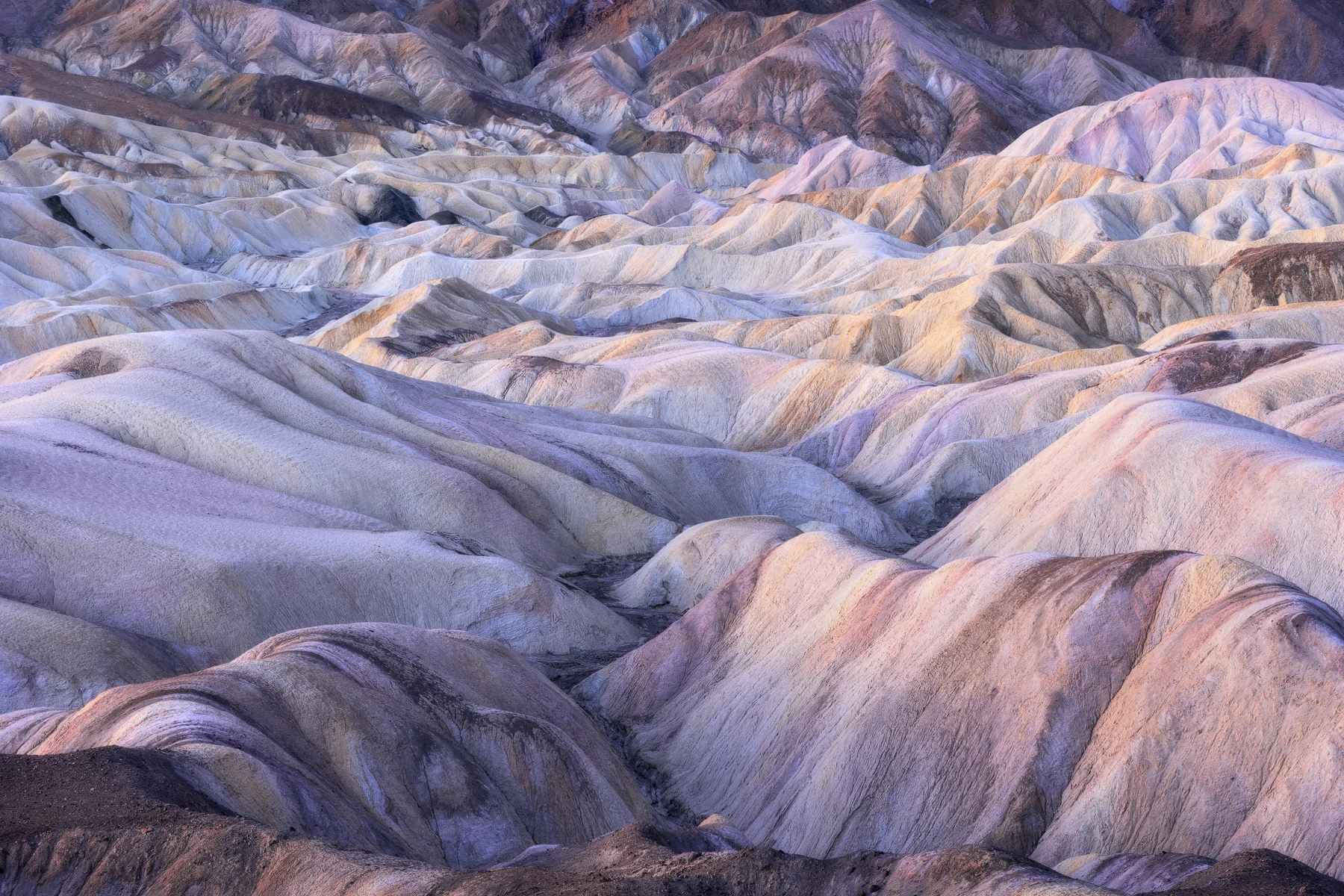
Death Valley National Park, California. 2020
Photographing Zabriskie Point in Death Valley is an experience that never fails to impress. While the main overlook is well-known and heavily visited, venturing just beyond the familiar viewpoints reveals an entirely new world of textures, colors, and formations that make this landscape truly unique. If you step off the well-trodden path and explore the terrain to the north, you’ll find an intricate maze of eroded ridges, deep ravines, and striations in shades of gold, ochre, and soft pink—characteristics that have made Death Valley famous among landscape photographers and geologists alike.
This particular morning marked my first experience seeing this specific section of Zabriskie Point at dawn. The night before, I had hiked deeper into the interior, immersing myself in the solitude and raw beauty of the terrain. The silence in these remote areas is something difficult to describe—there’s a stillness that enhances every detail, from the wind-carved ridges to the subtle shifts in light. It’s an environment that rewards those who take the time to explore beyond the obvious.
Photographers are especially drawn to Zabriskie Point for its endless compositions and dramatic lighting. The best time to photograph this area is during twilight, specifically blue hour, when the soft, indirect light allows the rich hues of the landscape to emerge in full depth. Unlike the harsh sunlight of midday, twilight enhances the intricate textures of the badlands, bringing out the subtleties in the rock formations and allowing for a more dynamic and painterly image.
Few places offer the kind of raw, untouched beauty found in Death Valley, and Zabriskie Point remains one of the most captivating locations to witness and capture the desert’s ever-changing light.